July 15, 2026 / Preserve the mansion; audit the estimate.
I am a full-time material-culture historian and preservationist; my field necessarily includes the visual arts, architecture, architectural fragments, and historic artifacts. I also have an advanced education in economic theory. I once saved an 1848 stone house with $20,000. I therefore understand both historic preservation and the economic difference between stabilization, conservation, restoration, reconstruction, and municipal extravagance.
Damned tax-and-spend former Mayor Eileen Weir is now promoting another municipal money grab. When I asked her why the figure was $18 million, she appeared visibly shaken by the question. One would have thought that she could not pay her own rent unless the entire sum went through.
The preliminary figures are $7.5 million for the Bingham-Waggoner Estate, $4.5 million for the Vaile Mansion, $589,000 for the Log Courthouse, and $1.5 million for the Truman Memorial Building. Then somebody added a staggering 30 percent contingency and arrived at the conveniently inflated figure of $18 million.
Why $18 million?
Why is the choice repeatedly presented as an extortion-like demand for the entire amount or the loss of the buildings?
Give us all your money, or we will give away your heritage to McClain again!
The City threatened to sell the two great houses; public opposition stopped it. Now we are presented with another manufactured emergency in which taxpayers supposedly must finance every deferred repair, administrative ambition, consultant’s recommendation, contingency, and ornamental improvement at once. These are empty mansions that the City might eventually sell for one dollar even after the taxpayers have paid millions to repair them.
Preservation does not mean making an old building new again. It means keeping the building standing; stopping water infiltration; securing the roof, foundation, masonry, windows, and mechanical systems; and preserving what is historically significant. Stabilization is not renovation. Conservation is not municipal remodeling. A historic house does not require the fixtures, finishes, conveniences, and capital budget of a new convention center.
Begin with $100,000 per house. Identify the immediate threats. Stop the water. Repair the roofs. Brace what is moving. Repoint what is failing. Preserve the original materials instead of replacing them. Then proceed by documented priorities, private fundraising, grants, volunteer labor, donated materials, and work performed in defined phases.
Why is Eileen Weir involved in promoting the largest possible number; and why is she so adamant about the dollars rather than the preservation work itself? Why does every proposal begin with what government wants to spend rather than with what the buildings actually require?
This is the same government that punishes citizens for improving their own property. A taxpayer saves enough from his earnings to paint his porch, replace a roof, or repair a deteriorated house; the reward is a higher property-tax assessment. The City then demands still more of his earnings to perform work upon municipal houses larger than the homes of the people being taxed.
Jesus, please allow the factory workers, farm workers, retirees, and small-business founders to retain some portion of their meager earnings and the fruits of their frugality.
This is my own photograph of the Harvey M. Vaile Mansion, completed in 1881 at 1500 North Liberty Street in Independence, Missouri. I presently own a house on Liberty Street and previously lived on Liberty Street twice. I love the words “Liberty” and “Missouri” together. I always vote for liberty and independence.
The mansion was designed by Kansas City architect Asa Beebe Cross in the Second Empire style: a symmetrical brick composition dominated by mansard roofs, dormers, bracketed cornices, limestone ornament, and a tall central tower. It contains thirty-one rooms with fourteen-foot ceilings, nine marble fireplaces, original decorative painting, speaking tubes, hot and cold running water, flush toilets, and a built-in 6,000-gallon water tank. It was reputedly the first residence in Jackson County equipped with indoor plumbing.
Harvey M. Vaile accumulated his fortune through law, land, transportation ventures, business interests associated with the Erie Canal, and ownership in a United States Star Route mail operation extending from Independence toward Santa Fe. The property included vineyards and a wine-processing operation with cellar capacity reportedly reaching 48,000 gallons. Two surviving chandeliers were reportedly among three originally intended for the White House but purchased by Vaile after imperfections caused their rejection.
This is an important house. It should be preserved. That does not mean that every frightened taxpayer must surrender his earnings whenever a former mayor or municipal consultant announces an enormous round number.
Preserve the mansion; audit the estimate.
April 2020 / My own photograph
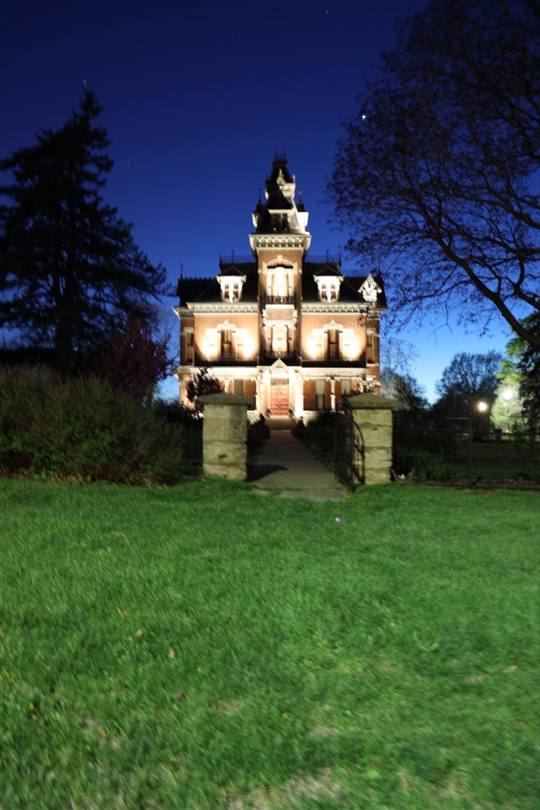
We took this evening photograph of the nearby 1881 Harvey M. Vaile Mansion, located at 1500 North Liberty Street in Independence, Missouri. This is Second Empire architecture. Vaile made his fortune building the Erie Canal (which passes Palymra, N.Y.) and afterward a mail route to New Mexico over the Santa Fe Trail.
The house has 30 or 40 rooms covering 16,800 sq. ft., trimmed in milled black oak and walnut, with the first indoor plumbing in Jackson County, a 48,000-gallon wine celler, nine marble fireplaces, and the chandeliers originally intended for the White House.
Many visitors to my home of Independence, Missouri, miss this site. We also have the the 1831 first Mormon temple lot, the site of the printing of the first Mormon newspaper 1832-1833, the new Midwest Genealogy Center, the National Frontier Trails Musem, the Harry S. Truman Presidential Library and Museum, the Truman "Winter White House," and of course my house with more Mormon-content books in one place than even BYU or the Church History Library.